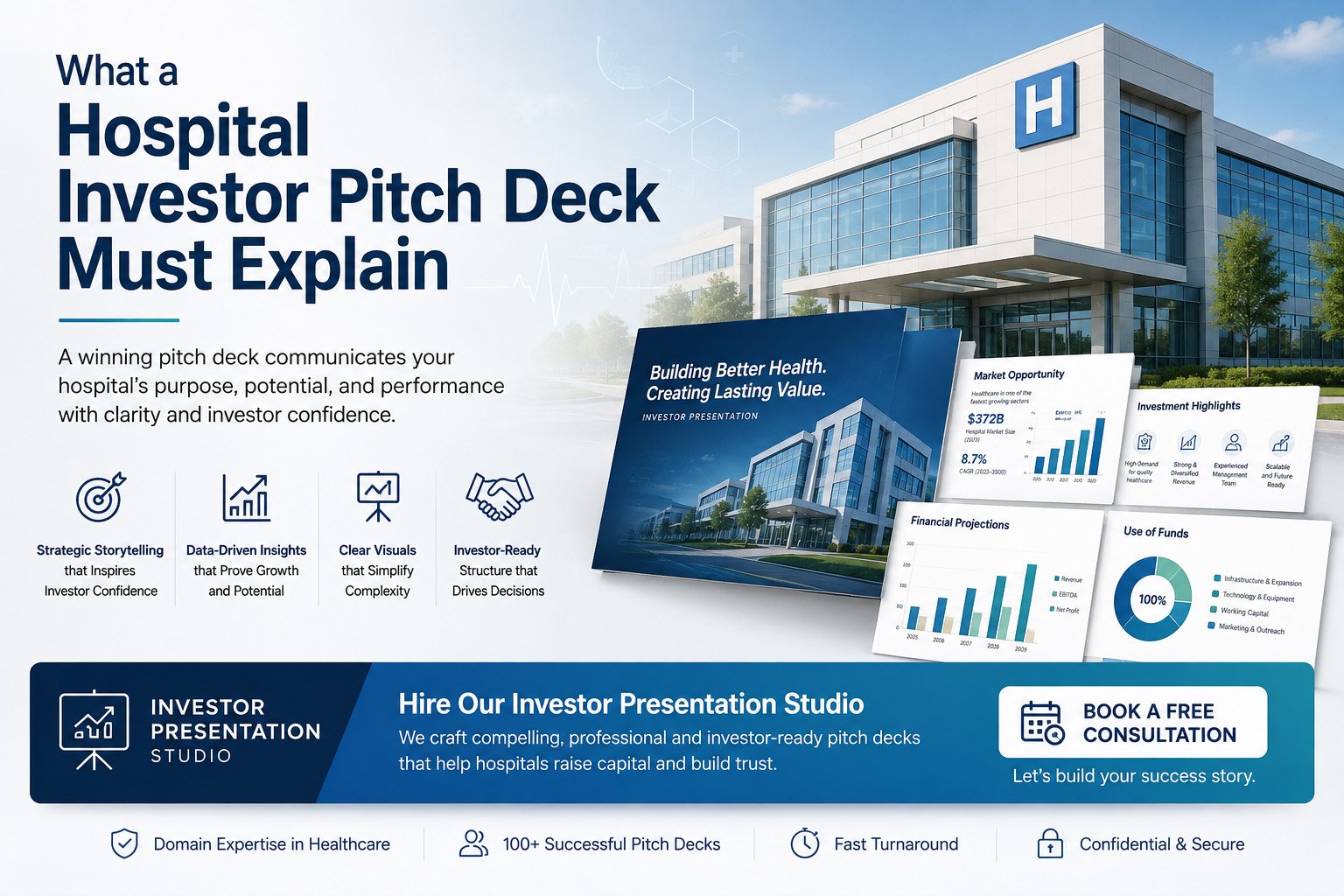
What a Hospital Investor Pitch Deck Must Explain
A hospital investor pitch deck is not simply a presentation about a healthcare project. It is a structured investment document designed to explain why the proposed hospital is needed, how it will operate, what makes it commercially viable, and how investors may generate sustainable returns from the project.
For hospital developers, healthcare entrepreneurs, medical groups, landowners and institutional promoters, a professionally designed hospital investor pitch deck can become one of the most important tools for raising capital, approaching lenders, presenting to private equity firms, engaging strategic healthcare partners or securing investment from family offices.
At INVESTOR PRESENTATION STUDIO, we help healthcare promoters transform complex hospital projects into clear, visually compelling and investor-ready presentations that communicate the business opportunity with confidence.
1. The Healthcare Investment Opportunity
Every hospital investor presentation should begin by answering a fundamental question:
Why should this hospital be developed in this market?
Investors need to understand the healthcare demand behind the project.
The presentation should explain:
- Population and demographic profile
- Existing healthcare infrastructure
- Number of hospitals and hospital beds in the catchment
- Bed-to-population ratio
- Demand for specialised medical services
- Patient leakage to other cities
- Local income profile and insurance penetration
- Corporate and institutional healthcare demand
- Medical tourism potential
- Future healthcare demand drivers
A strong healthcare market analysis helps demonstrate that the proposed hospital is responding to a measurable and sustainable demand.
2. Hospital Project Vision
Investors need to understand exactly what kind of healthcare facility is being proposed.
The hospital investor pitch deck should clearly explain:
- Proposed hospital type
- Number of beds
- Hospital category
- Medical specialties
- Target patient segments
- Proposed location
- Land area
- Approximate built-up area
- Project positioning
- Expansion strategy
For example, the project may be positioned as:
- Multispeciality hospital
- Super-speciality hospital
- Women and children's hospital
- Cancer hospital
- Cardiac hospital
- Orthopaedic hospital
- Day-care hospital
- Rehabilitation hospital
- Medical campus
- Integrated healthcare destination
Clear project positioning allows investors to understand the scale and strategic direction of the development.
3. Location and Catchment Analysis
Hospital performance is strongly influenced by location.
A professional hospital investment presentation should explain why the selected site is suitable for healthcare development.
Important factors may include:
- Road connectivity
- Proximity to major residential areas
- Nearby towns and cities
- Highway accessibility
- Airport connectivity
- Catchment population
- Emergency accessibility
- Visibility from major roads
- Availability of supporting infrastructure
- Future urban development
Maps, demographic diagrams and healthcare catchment graphics can help investors quickly understand the strategic value of the location.
4. Hospital Master Plan and Development Concept
Healthcare investors often need to visualise how the proposed hospital will function physically.
The pitch deck can include:
- Conceptual hospital master plan
- Site planning
- Hospital zoning
- Patient circulation
- Emergency access
- Ambulance movement
- Public entrance
- Service circulation
- Parking strategy
- Future expansion zones
- Landscape and healing spaces
For larger healthcare developments, the presentation may also explain future phases such as medical colleges, nursing institutes, diagnostic centres, rehabilitation facilities or healthcare retail.
A professionally illustrated hospital master plan can make a complex healthcare development much easier for investors to understand.
5. Hospital Planning and Department Mix
The investor should understand how the hospital is planned operationally.
Typical departments may include:
- Emergency department
- Outpatient department
- Inpatient wards
- Intensive care units
- Operation theatres
- Diagnostic imaging
- Pathology laboratory
- Pharmacy
- Dialysis
- Cardiology
- Oncology
- Orthopaedics
- Maternity
- Paediatrics
- NICU
- PICU
- Rehabilitation
- Administration
- Food and dietary services
- Medical stores
- Utility and engineering areas
The department mix should be linked to the hospital's target market and revenue strategy.
6. Bed Mix and Capacity Planning
Hospital investors need clarity regarding the proposed bed capacity.
The pitch deck may show the distribution of:
- General ward beds
- Semi-private rooms
- Private rooms
- Deluxe rooms
- ICU beds
- NICU beds
- PICU beds
- Emergency observation beds
- Day-care beds
This helps investors understand how the facility is positioned and how different patient segments may contribute to hospital revenue.
7. Healthcare Market Gap
One of the strongest parts of a hospital investor pitch deck is identifying the healthcare gap.
The presentation should demonstrate where demand exceeds existing healthcare supply.
This may include:
- Shortage of hospital beds
- Lack of specialist hospitals
- Limited diagnostic facilities
- Long travel distances for treatment
- High patient referral to larger cities
- Lack of advanced surgical services
- Insufficient emergency healthcare
- Growing insurance-based healthcare demand
When supported by credible market data, these gaps can help establish a compelling investment case.
8. Competitive Landscape
Investors will want to know which hospitals already operate within the market.
A hospital competitive analysis may compare:
- Hospital name
- Distance from project site
- Number of beds
- Major specialties
- Hospital category
- Estimated occupancy
- Target market
- Strengths
- Market gaps
The objective is not simply to show competitors, but to demonstrate how the proposed hospital can differentiate itself.
9. Patient Volume Assumptions
The pitch deck should explain how the hospital expects to generate patient demand.
Important assumptions may include:
- OPD patients per day
- Emergency patients
- Inpatient admissions
- Average length of stay
- Bed occupancy rate
- Surgical procedures
- Diagnostic volumes
- Pharmacy utilisation
- Day-care procedures
These assumptions form the foundation of the hospital's financial projections.
10. Hospital Revenue Model
Investors should clearly understand how the hospital will generate revenue.
Typical revenue sources may include:
- Inpatient services
- Outpatient consultations
- Surgery and procedures
- Diagnostic imaging
- Laboratory services
- Pharmacy
- Intensive care services
- Emergency services
- Dialysis
- Oncology treatment
- Rehabilitation
- Preventive health packages
- Corporate healthcare contracts
- Insurance patients
Presenting the revenue model in clear visual charts helps investors understand the business structure quickly.
11. Hospital Development Cost
A hospital investor presentation should provide a transparent overview of project costs.
Typical development costs may include:
- Land cost
- Architectural and engineering design
- Civil construction
- Medical planning
- Interior development
- Medical equipment
- MEP systems
- HVAC
- Electrical systems
- Hospital IT systems
- Furniture
- Pre-opening expenses
- Marketing
- Working capital
- Contingency
Investors need to understand both the overall capital requirement and how that capital will be utilised.
12. Medical Equipment Investment
Medical equipment can represent a significant portion of hospital development costs.
The pitch deck may provide indicative equipment budgets for departments such as:
- Radiology
- Operation theatres
- ICU
- Laboratory
- Emergency
- Cardiology
- Dialysis
- Oncology
- CSSD
- Endoscopy
A phased equipment procurement strategy can sometimes help reduce initial capital requirements.
13. Financial Projections
Financial projections are one of the most important parts of a hospital investor pitch deck.
The presentation may include:
- Projected revenue
- Operating expenses
- EBITDA
- EBITDA margin
- Net profit
- Cash flow
- Break-even analysis
- Hospital occupancy projections
- Average revenue per occupied bed
- Capital expenditure
- Working capital
- Return on investment
Financial assumptions should remain realistic, clearly explained and internally consistent.
14. Hospital Occupancy Ramp-Up
Hospitals generally take time to achieve stable occupancy.
Investors should understand the projected ramp-up period.
For example, the presentation may demonstrate how occupancy could gradually increase during the first several years of operation.
A realistic occupancy strategy gives investors greater confidence than aggressive assumptions unsupported by market demand.
15. Funding Requirement
The investor presentation should clearly state how much capital is required.
Funding may be required for:
- Land acquisition
- Hospital construction
- Medical equipment
- Pre-opening costs
- Working capital
- Expansion capital
The pitch deck should clearly explain the total project cost, promoter contribution and external funding requirement.
16. Use of Funds
Investors need transparency regarding how their capital will be deployed.
A clear Use of Funds slide may divide investment across:
- Civil construction
- Medical equipment
- MEP systems
- Hospital interiors
- IT infrastructure
- Pre-opening expenses
- Working capital
- Marketing and commissioning
Visual charts can make this information easier to understand.
17. Investment Structure
Depending on the project, the investor pitch deck may explain possible investment structures such as:
- Equity investment
- Strategic healthcare partnership
- Joint venture
- Private equity
- Family office investment
- Institutional investment
- Developer partnership
- Debt and equity combination
The exact investment structure should be developed in consultation with appropriate financial and legal advisors.
18. Project Development Timeline
Healthcare projects involve several stages.
The investor pitch deck should explain the expected development schedule.
Typical stages may include:
- Feasibility study
- Concept planning
- Hospital architectural design
- Statutory approvals
- Detailed engineering
- Construction
- Medical equipment procurement
- Recruitment
- Hospital commissioning
- Operational launch
A clear development roadmap demonstrates that the promoter understands the complexity of delivering the hospital project.
19. Management and Operating Strategy
Investors also invest in the team behind the project.
The hospital investor presentation should introduce:
- Promoter background
- Healthcare experience
- Medical leadership
- Hospital management team
- Operating partner
- Clinical advisory team
- Project consultants
- Architects and planners
If an established hospital operator or healthcare management company is involved, this can significantly strengthen the investment narrative.
20. Project Risks and Mitigation
Professional investors understand that every hospital project involves risk.
A credible presentation should identify risks such as:
- Construction cost escalation
- Approval delays
- Recruitment challenges
- Competition
- Lower-than-expected occupancy
- Medical equipment costs
- Regulatory changes
- Working capital requirements
The presentation should also explain the corresponding mitigation strategies.
What Makes a Hospital Investor Pitch Deck Investor-Ready?
A hospital pitch deck becomes effective when complex healthcare information is translated into a clear investment story.
The investor should be able to quickly understand:
The Opportunity → The Market → The Hospital Concept → The Development Strategy → The Financial Model → The Funding Requirement → The Investment Potential
The strongest presentations combine professional storytelling with healthcare planning, market research, financial information and high-quality visual communication.
Why Professional Presentation Design Matters
Hospital developments can involve large capital investments and complex technical information.
Poorly structured presentations can make even strong projects appear difficult to understand.
A professionally designed hospital investor pitch deck can help:
- Simplify complex information
- Improve investor confidence
- Present financial data clearly
- Explain the healthcare opportunity
- Visualise the hospital development
- Communicate the investment strategy
- Support investor meetings
- Improve credibility with funding partners
Hire Our Investor Presentation Studio
If you are developing a hospital, multispeciality healthcare facility, medical campus or specialist healthcare project and need to present the opportunity to investors, lenders, private equity firms, family offices or strategic partners, our Investor Presentation Studio can help.
We create professional, investor-ready healthcare presentations combining:
- Hospital project storytelling
- Healthcare market analysis
- Hospital masterplan presentation
- Development strategy
- Financial storytelling
- Data visualisation
- Investment highlights
- Use of funds
- Funding requirement
- Investor presentation design
- Healthcare pitch deck graphics
Our objective is to transform complex hospital development information into a clear, persuasive and visually professional investment presentation.
Planning a Hospital Development?
Build a presentation that helps investors understand the opportunity, project strategy and commercial potential.
Hire INVESTOR PRESENTATION STUDIO for your Hospital Investor Pitch Deck, Healthcare Investment Presentation or Hospital Development Proposal.